Friday, February 21, 2020

Iran, Hezbollah stir chaos in Syria's southwest

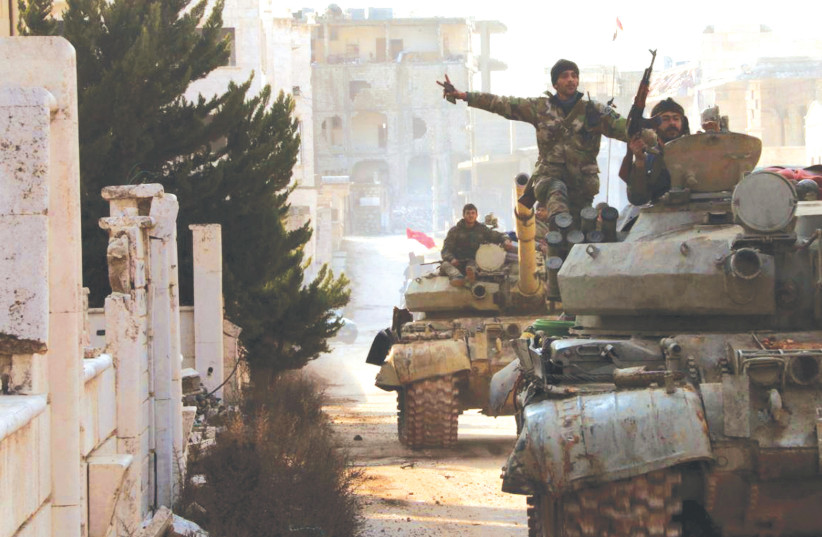
SYRIAN ARMY soldiers gesture last week in Kafr Hamra, in Syria’s Aleppo province. (photo credit: SANA/REUTERS)

The global spotlight has currently returned to Syria because of the Assad regime’s current bloody offensive in Idlib, Aleppo and Latakia provinces. The regime is trying to reduce the last enclave held by the Sunni Arab rebels in the country’s northwest.
The assault has precipitated one of the worst humanitarian disasters of the bloody, nine-year war. Eight hundred thousand people have left their homes to flee the advance of regime forces and the relentless, indiscriminate bombing of Assad’s Russian allies.
Far to the south of Idlib, however, and largely ignored by the global media, events are under way that may offer a clue to the future direction of Syria. These events are of direct interest to Israel.
The regime is currently seeking to consolidate its presence in Deraa and Quneitra provinces in Syria’s southwest. Assad’s army completed its “conquest” of these areas in the summer of 2018.
Observation of the current situation on the ground in these areas suggests, however, that the situation remains far from a return to the repressive and stifling order of the pre-revolt days.
Rather, the situation is characterized on the one hand by extensive Iranian and Hezbollah activity within the empty shell of the government’s structures, and on the other hand by an ongoing, armed resistance to that government. The precise organization, origins and nature of this resistance remain somewhat mysterious. But the tempo of attacks on regime positions and facilities is relentless, and increasing.
Deraa is where the Syrian rebellion broke out, in distant early 2011. Nine years on, it is not yet silenced. Rather, the area and its environs increasingly constitute Syria’s wild southwest.
REGARDING IRANIAN and Hezbollah activity, the extensive human infrastructure maintained by Iran and its proxy in southwest Syria has been well documented.
In a recent report produced by the Jerusalem Center for Public Affairs (JCPA), Brig.-Gen. (ret.) Shimon Shapira and Col. (ret.) Jacques Neriah noted that since the return of the area to regime control, Hezbollah has been actively recruiting. The recruits come from among the area’s impoverished Sunni communities. They are tempted into the ranks by financial inducements. Hezbollah pays $250 a month, according to Shapira and Neriah. Three thousand five hundred local Syrians have been recruited in this way since mid-2018, according to the report.
They further note that the Hezbollah commander behind these efforts is 50-year-old Munir Naima Ali Shaito, known as Haj Hashem. Shaito is a veteran and senior Hezbollah operative, and is former deputy commander of the elite Badr unit within the organization.
The Syrian Observatory for Human Rights, a pro-opposition but generally reliable source, reported this week that Iran-backed militia commanders have begun to offer financial incentives to the mukhtars of villages in the Syrian-controlled part of the Golan, in return for their cooperation in recruiting village youth to the militias’ ranks. Among the villages named by the observatory are al-Habiriyah and Sultanah.
Iranian efforts in this area are not taking place in isolation from the official regime structures. Rather, in the manner Tehran favors, its operatives both cooperate with regime forces and operate from within them.
The powerful Air Force Intelligence Directorate and the 4th Armored Division, commanded by Bashar Assad’s brother Maher, are the Islamic Revolutionary Guard Corps’ chosen partners in southwest Syria. Hezbollah maintains an intelligence gathering facility within a base of the Syrian Arab Army’s 90th Brigade in the Hadr area, very close to the border with Israel, according to the JCPA report.
The implications of this information are significant. The notion that an unproblematic return of the antebellum status quo and of the strong prewar Baathist state is taking place in areas where the regime has replanted its flag needs to be complicated. What is returning is something different – namely, the shell of the prewar regime, within which Iran and its allies appear to have unfettered freedom of action.
THEY ARE not having things all their own way, though. Since June 2019, according to the observatory, more than 300 attacks have taken place on regime and allied forces in the Deraa area. These have included shootings, and detonations of IEDs and mines. One hundred ninety-two people have been killed in these attacks, including 36 civilians and 100 members of the regime forces, and its “loyalists and collaborators,” according to the observatory.
The latest attacks came this week, when unidentified gunmen fired on an Air Force Intelligence checkpoint at the southern entrance to al-Musayfirah town in Deraa’s eastern countryside.
The precise figures produced by the observatory should be treated with some skepticism. Southwest Syria is closed to media coverage and so there is no way of verifying these. But the ongoing attacks on regime forces and facilities are confirmed from other sources and are not in doubt.
So what is behind these actions?
Haid Haid, a respected Syrian researcher on the war, notes that the regime’s continued arrests and violations of amnesty agreements with locals may be motivating the return to resistance.
An organization calling itself Popular Resistance (Al-Muqawama al-Sha’abia) has emerged and has begun to claim responsibility for the attacks. The group, as reported by Haid, gave an interview to an Arabic news site in November, declaring war on the regime and its associated militias. In the interview the spokesman, calling himself Saif al-Horani, said that the group has no affiliation with any foreign state or entity.
Haid notes, however, that no further information is available on this group. Doubts have emerged whether it exists at all, or whether it is simply an effort to take credit for acts committed by others. There is also the possibility that the overt “leadership” of Popular Resistance is an attempt by the regime to draw its opponents in Deraa into the daylight, so that they can be neutralized.
Identifying those behind Popular Resistance is important. A question of particular interest will be the role of Sunni jihadis affiliated with Islamic State or Hayat Tahrir al-Sham in these actions. No evidence of either has emerged as yet. The perpetrators remain shrouded in mystery. But the attacks are continuing and increasing.
Events in Syria’s southwest matter for Israel because the chaos and the continued weakness of the Syrian state allow Iran to advance by stealth, organizing in the direction of Israel’s border.
More broadly, Deraa and Quneitra are worth watching with care, because they show that contrary to the impression conveyed in regime and Russian propaganda, normality is not returning to Syria with the advance of the regime’s flag.
Rather, in Syria’s wild southwest, what exists is a chaotic failed state, thoroughly penetrated by outside powers, and facing an ongoing, inchoate but deadly insurgency at the hands of those it claims to have vanquished.
The writer is director of the Middle East Center for Reporting and Analysis and a research fellow at the Middle East Forum and at the Jerusalem Institute for Strategy and Security. He is the author of Days of the Fall: A Reporter’s Journey in the Syria and Iraq Wars.

Saudi Arabia says it intercepted missiles fired from Yemen

Houthi rebel fighters display their weapons during a gathering aimed at mobilising more fighters in Sanaa, Yemen [File: Hani Mohammed/AP]

Saudi-led coalition says several ballistic missiles launched by Houthi rebels were aimed towards Saudi cities.


Saudi Arabia says it has intercepted and destroyed several ballistic missiles launched by Yemen's Houthi rebels towards Saudi cities, in the latest cross-border attack.
The missiles were fired from the Yemeni capital, Sanaa at 12:30am Friday and were aimed at cities and civilians, the Saudi-UAE-led coalition fighting the Yemeni group said, Saudi state news agency SPA reported.
"They were launched in a systematic, deliberate manner to target cities and civilians, which is a flagrant defiance of international humanitarian law," coalition spokesman Turki al-Malki said, according to the SPA.
"The capital (Sanaa) has become a Houthi militia assembly, installation and launching-hub for ballistic missiles that target the kingdom," he added.
A Houthi military statement said the group had successfully attacked oil giant Saudi Aramco and sensitive targets in the Red Sea port city of Yanbu using drones and ballistic missiles, without providing evidence.
A Houthi spokesman quoted by the rebels' al-Masirah TV on Friday stressed that the targets "were hit with precision" and promised further attacks against Saudi Arabia in "case of continued aggression and economic blockade".
Aramco, the kingdom's state-owned oil company, declined to comment.
The incident comes ahead of a gathering of finance ministers and central bankers from the Group of 20 major economies in Riyadh.
The G20 meeting continued as scheduled. It was unclear if any of the projectiles had been fired towards Riyadh, which has been targeted previously.
Saudi Arabia has repeatedly accused Iran of supplying sophisticated weapons to the Houthis, a charge Tehran denies.
The coalition intervened in support of the Yemeni government in 2015 when President Abd-Rabbu Mansour Hadi fled into Saudi exile as the rebels closed in on his last remaining territory in and around Aden.
Tens of thousands of people, many of them civilians, have been killed in the conflict, relief agencies say.
The fighting has triggered what the United Nations describes as the world's worst humanitarian crisis, with millions displaced and in need of aid.

Sri Lankan parliamentary committee proposes immediate burqa ban

According to the report, a number of countries have already banned the burqa.

The report suggested that the police should have the power to ask anyone wearing a face covering in a public place to take off such clothing in order to establish the identity of the person

A Sri Lankan parliamentary committee on national security has proposed an immediate ban on the burqa and suspending the registration of political parties on ethnic and religious basis, following the Easter Sunday terror attack that killed over 250 people.
The proposals featured in a special report presented in Parliament on Thursday to resolve 14 controversial issues following the April 21 Easter attack last year. The report was tabled by MP Malith Jayatilaka, Chairman Sectoral Oversight Committee on National Security, the Daily Mirror reported.
According to the report, a number of countries have already banned the burqa.
The report suggested that the police should have the power to ask anyone wearing a face covering in a public place to take off such clothing in order to establish the identity of the person.
If such a request is not complied with, police should have the power to arrest the individual without a warrant, the report said.
It also recommended the country’s Election Commission to enact a legislation to suspend the registration of political parties on ethnic and religious basis.
The report also said that the registration of political parties which have some racial or religious conflict or in its name should also prohibited.
Such a party should be converted into a political or non-religious political party within a specified period of time, the report said.
The report states that all students studying in madrassas should be absorbed into the normal school system under the Ministry of Education within three years.
The report also proposes to establish a special committee to regulate the madrasas under the Department of Muslim Religious and Cultural Affairs.
Nine suicide bombers belonging to local Islamist extremist group National Thawheed Jamaat (NTJ) carried out a series of devastating blasts that tore through three churches and three luxury hotels on the Easter Sunday, killing 258 people, including 11 Indians.

Saudi Agents Infiltrate Twitter for Information

Two employees of Twitter accessed personal information and IP addresses of Saudi dissidents in 2015.  Photo: Amr Nabil / AP

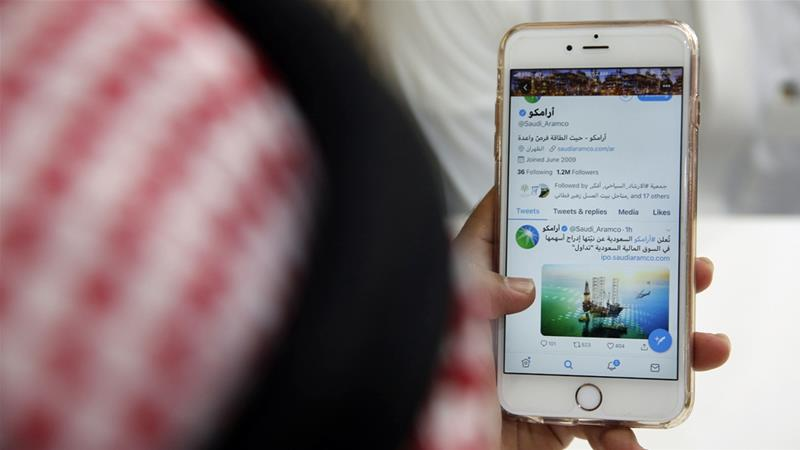
Two former Twitter employees have been charged with using their positions to spy for Saudi Arabia. The charges, revealed in San Francisco this week, accuse the employees of being paid by the Saudi government to discover the personal information of Twitter users, including several notable critics of the Kingdom. 

It is the first time that Saudi Arabia has been charged with spying within the United States. The accused employees are Ali Alzabarah, a Saudi citizen, and Ahmad Abouammo from the US. A third man, Ahmed Almutairi, also a Saudi, is also alleged to be an intermediary between Saudi officials and the Twitter employees.

Abouammo is the only one currently in the US, as Alzabarah and Almutairi are both believed to be in Saudi Arabia. Abouammo has also been charged with obstructing an FBI investigation into his conduct after agents visited his home. He allegedly created a fake invoice on his computer, stating that a payment of $100,000 from a Saudi official was for “consulting services.” 

Throughout 2015, the two employees accessed the information of over 6,000 Twitter users, including at least 33 usernames for which Saudi Arabian law enforcement had submitted emergency disclosure requests. Among the users whose information was leaked is Omar Abdulaziz, a prominent dissident who was close to murdered journalist Jamal Khashoggi. 

Due to their high positions within Twitter, Abouammo and Alzabarah were able to access information such as the IP addresses of users, in addition to tracking all of their usage on the platform. A note found in a Saudi official’s email account references the scope of this data, stating a user’s IP address, time and date of access, and the device through which they were using Twitter.

The charges cast doubt on the ability of Twitter to protect the sensitive data of its users from foreign agents. In response to the news, Twitter stated, “We understand the incredible risks faced by many who use Twitter to share their perspectives with the world and to hold those in power accountable. We have tools in place to protect their privacy and their ability to do their vital work. We're committed to protecting those who use our service to advocate for equality, individual freedoms, and human rights.”

4 civilians killed in Daesh attack on Kirkuk, Iraq

Iraqi soldiers conduct a military operation against Daesh at the rural areas of Saladdin and Kirkuk, Iraq on 29 December 2019. [ Alı Makram Ghareeb - Anadolu Agency]

Four civilians were killed and several others were wounded in an attack by gunmen affiliated with Daesh in the Iraqi governorate of Kirkuk, Anadolu news agency.
The agency quoted an officer in Kirkuk police, Hamid Al-Ubaidi, as saying that “Daesh militants have attacked with machine guns the village of Jaghmagha near the Dibis district, south of Kirkuk governorate, and killed four civilians.”
Al-Ubaidi explained that the militants fled the scene to an unknown destination after the attack.
For its part, the Patriotic Union of Kurdistan in the Iraqi Parliament announced that seven Kurds were killed and wounded in the attack in Kirkuk and called for a review of the number of security forces present in “fragile areas”, holding the federal government responsible for the incident.
“We have repeatedly called for a solution to the repeated security breaches, and we warned against not taking serious measures on the security file in the province, but our calls have not been responded to,” it said in a statement.

Libya conflict: Tripoli rocket attacks halt peace talks

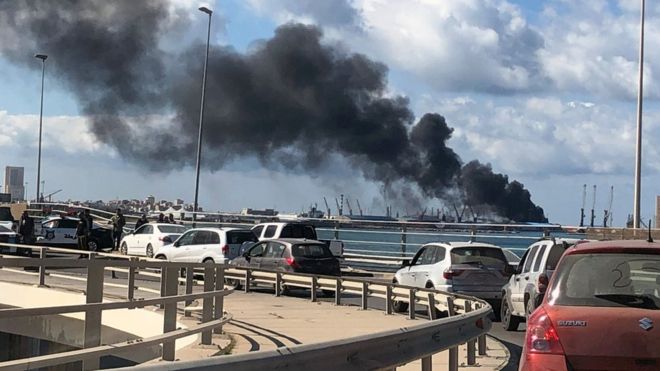
Smoke rises from the port in Tripoli after being attacked in Libya, 18 February 2020

It said the port was one of the targets struck by forces loyal to renegade General Khalifa Haftar, prompting the evacuation of fuel tankers.
The city has been under siege for almost a year, and relies heavily on shipping to feed its population.
Top negotiations to broker a lasting ceasefire between the two sides in the civil war have faltered several times.
"There can be no peace under the bombing," the UN-backed Government of National Accord (GNA) said.
"We are announcing the suspension of our participation in the military talks taking place in Geneva until firm positions are adopted against the aggressor [Gen Haftar]", it said.
The conflict in the oil-rich nation has been complicated by the role of foreign states.
Turkey passed a controversial law in January to deploy troops to help GNA forces in Tripoli. Qatar also backs the GNA, led by Prime Minister Fayez al-Sarraj,
Gen Haftar's Libyan National Army (LNA), which controls much of eastern Libya, has the backing of Russia, Egypt, Saudi Arabia, the United Arab Emirates (UAE) and Jordan.
UN chief António Guterres recently termed the conflict a "proxy war", adding in a recent interview with the BBC, that it was "unacceptable".
The fighting has left more than 1,000 people dead and forced some 140,000 from their homes, according to the UN.
Earlier this week, European foreign ministers meeting in the Belgian capital, Brussels, agreed to a new naval and air mission to stop more arms from reaching warring factions in Libya.
Libya has been torn by conflict since the 2011 uprising which ousted long-time strongman Muammar Gaddafi.

Iran has given Taliban anti-aircraft missiles


Iran has given anti-aircraft missiles to Taliban group amid soaring tensions between Washington and Tehran over regional issues that led to the killing of a top Iranian general in Iraq few weeks ago.
Reports regarding the delivery of anti-aircraft missiles to Taliban by Iran emerge as numerous Afghan and American planes faced crashes, hard-landings and emergency landings in the restive parts of the country.
While no definitive proof exists in this regard, the acting police chief of Uruzgan Sardar Mohammad Haya has told Radio Free Afghanistan “Iran has given the Taliban anti-aircraft missiles so that they can better target our aircrafts.”
Hayar further added “Numerous [recent] intelligence reports based on various sources detail this support.”
This comes as Washington has repeatedly been accusing Iran of supporting the militant groups in the Middle East and Afghanistan.
“Iran provides a range of financial, political, training and material support to groups which would include Hezbollah, Iraqi Shia militant groups, the Houthis in Yemen, some Palestinian groups, the Taliban and Bahraini Shia militants,” the Department of Defense said in a statement late in November last year.


Airstrikes kill 5 Taliban and ISIS-K militants in 3 provinces


A series of airstrikes killed 5 militants of the Taliban group and the offshoot of ISIL – ISIS Khurasan, in three provinces of Afghanistan in the past 24 hours.
The military officials said Wednesday an airstrike killed 3 Taliban militants in Nahr-e Saraj district of Helmand province.
The officials further added a similar airstrike killed a militant of ISIS Khurasan (ISIS-K) in Tswoky district of Kunar province in the East.
Another airstrike killed a Taliban militant in Deh Yak district of the restive Ghazni province in South-east of Afghanistan, the officials added.
The anti-government armed militants including Taliban and ISIS Khurasan have not commented regarding the airstrikes so far.
Both the Afghan and U.S. forces based in Afghanistan conducted regular counter-terrorism operations and airstrikes against Taliban, ISIS-K and other terrorist groups in the restive parts of the country.

Deadly Attacks on Christians in West Africa Underscore Need For France’s Anti-Jihad Mission

Image result for french military

Paris (CNSNews.com) – The importance of the presence of French troops in the Sahel region has been underlined by a series of recent deadly attacks targeting Christians in Burkina Faso, one of five countries where the French counter-jihadist mission is taking place.
Last Sunday, 24 worshipers were killed when terrorists attacked a Protestant church in the north of the country, the poorest in the region of Western/Central Africa known as the Sahel.
The regional governor, Colonel Salfo Kaboré, said armed jihadists identified, isolated and shot the worshippers. Apart from those killed, which included the pastor, 18 people were injured or abducted, he said, without specifying how many were missing.
Less than a week earlier, jihadists kidnapped seven people in the house of a Christian minister in eastern Burkina Faso, near the border with Niger. Three days later, the minister and four of the others were found dead nearby, according to local government officials. The remaining two, both women, were found unharmed.
And last December, 14 Christians were killed in a jihadist attack on another church in the country.
Christians in Burkina Faso have come under attack for four years. Several Muslim imams have also been assassinated by jihadists in the north.
France in 2013 launched in Operation Barkhane, a mission aimed at countering ISIS, al-Qaeda and Boko Haram in the region. More than 4,500 French soldiers are currently deployed in the five countries – Niger, Mali, Chad, Mauritania and Burkina Faso.
French President Emmanuel Macron pledged during a meeting early this year with the presidents of the five countries to keep his troops in the area as long as necessary because the insecure situation there.
He did so after asking the five whether they were in favor of the ongoing troop presence, and receiving a positive response.
Some politicians in Burkina Faso and Mali in particular have come out in opposition to the mission.
Last month around 1,000 people demonstrated in Mali’s capital, Bamako, against the French presence, with some members of President Ibrahim Boubacar Keita’s ruling party among the protestors. In Burkina Faso, a small demonstration took place in the capital, Ouagadougou, on January 13.
Macron has been calling on European and NATO allies to help Sahel countries’ militaries fight against the terrorists, but so far without success.
U.S. officials have indicated that American troops in the region may be withdrawn. Speaking on the sidelines of the Munich Security Conference at the weekend, Defense Secretary Mark Esper said he had engaged with his French counterpart, Florence Parly, about the issue for months now.
“I give the French credit for what they’ve done in Africa, particularly the Sahel,” he said. “They’ve been real leaders. They've been reaching out aggressively to get more European partners on board with mixed success. And I fully support that effort.”
There are reportedly some 6,000 U.S. troops stationed in Africa, with several hundred in the region in question. Esper spoke of his recently-announced decision to deploy a security force assistance brigade to Africa, saying the SFAB “can do train-and-assist better than anybody else.”
In turn, that move allows him to bring back to the U.S. elements of an infantry brigade from the 101st Airborne Division, “so they can go back and get ready, prepare, and focus on their [National Defense Strategy] mission.”
Esper said it would be good if more European troops would join France in the fight – which is what Macron has been pushing for since  last November, when 13 French soldiers were killed in a helicopter crash during an operation against jihadists.
During his summit with the five African leaders, Macron called on President Trump not to pull U.S. troops from Africa, saying the terrorists were still very active.
During a visit to Senegal early this week, Secretary of State Mike Pompeo said he was in favor of a collective” approach with U.S. allies, when it comes to troop deployments against jihadist insurgents in Africa.
“We have an obligation to get security right here, in the region. It’s what will permit economic growth and we’re determined to do that.”


Pompeo said he had no announcement to make with regard to U.S. troop drawdowns in the region.

Ship seizures included ‘relatively new’ Iranian surface to air missile bound for Houthi rebels in Yemen


U.S. military officials said Wednesday that the seizures of weapons by two U.S. Navy warships in the Arabian Sea in November and February included newly designed Iranian surface-to-air missiles among other weaponry bound for Houthi rebels in Yemen.

The Nov. 2019 boarding of a small boat by the guided-missile destroyer Sherman also seized components for the 351 land attack cruise missile — the same missile U.S. officials claim was used in mid-September attack on two Saudi Arabian oil fields.

Capt. William Urban, the lead spokesman for U.S. Central Command, told reporters Wednesday that the seized missile components were “relatively new” Iranian-manufactured missiles that have not been “widely distributed.”

Urban explained that the missile systems had not been seen in Yemen prior to the conflict. He said the shipments of the advanced weaponry fit a pattern carried out by Iran.

Urban said there have been six ship interdictions by American warships in the CENTCOM area of responsibility over the last five years involving illicit smuggling of arms to Iranian proxies in the region. Two of the ship boardings have occurred within the last four months.
The Sherman boarded a small vessel in Nov. 2019, and recently the Ticonderoga-class guided-missile cruiser Normandy interdicted a boat in February.

Urban told reporters that the recent seizures were not necessarily a sign of an uptick in Iranian operations to supply proxy militias across the region.

Qatar FM denies claims it supports terrorism in Syria

Qatari Foreign Minister Mohammed bin Abdulrahman bin Jassim Al Thani in Tehran, Iran on 4 January 2020. [Iranian Presidency / Handout - Anadolu Agency]

The Qatari Minister of Foreign Affairs, Sheikh Mohammed Bin Abdulrahman Al Thani, yesterday denied claims that Doha has provided support for any of the terrorist groups in Syria explaining that his country has only supported the Syrian people through humanitarian organisations.
The Qatari minister told reporters in Brussels that “supporting the Syrian opposition at one point was a collective effort by a group of countries”.
Al Thani described all criticism directed at his country over allegedly supporting terrorism in Syria, Libya and the Sahel as “a malicious campaign” led by the countries that have imposed a blockade on Qatar for more than three years.
On 5 June 2017, Saudi Arabia, the UAE, Egypt, and Bahrain severed diplomatic and economic ties with Qatar, accusing it of supporting terrorist groups in the region.
The four countries also imposed an embargo on Qatar and issued a long list of demands, including the closure of Doha-based news broadcaster Al Jazeera, under the threat of further sanctions.
Qatar has refused to submit, denying charges that it supports terrorism and describing the bloc’s efforts to isolate it as a violation of international law and an infringement of its national sovereignty.

Thursday, February 20, 2020

Palestinians Must ‘Shut Up’ Or Make Peace With Israel, Saudi Crown Prince


‘Palestinian issue is no longer a priority for Saudi Arabia,’ Bin Salman said.


During a meeting with American Jewish organisations in New York last month, MBS claimed: “In the last several decades the Palestinian leadership has missed one opportunity after the other and rejected all the peace proposals it was given.”
Speaking to the Jewish organizations, he added: “It is about time the Palestinians take the proposals and agree to come to the negotiations table or shut up and stop complaining.”
He also said that the Palestinian issue was not a priority for the Saudi government, which “has much more urgent and important issues to deal with” like Iran.
MBS also urged Israel and the Palestinians to advance peace talks in order to pave the way for his country and other Gulf countries to normalise relations with Israel.
Saudi Arabia and Israel have grown increasingly close in the past few years, as both countries are allegedly concerned about the claimed threat of Iran and its allies in the region.
During his American tour, MBS told “60 Minutes” that Iranian Supreme Leader Ayatollah Ali Khamenei was “very much like Hitler.” He also told The Atlantic that Jews “have the right to own the land of Palestine.”

3 killed as terrorists ambush bus in Kenya

Image result for al shabaab

Three people were killed in an attack claimed by the al-Shabaab terror group in northern Kenya, local police said on Wednesday.
A 58-seater bus heading to capital Nairobi from the border town of Mandera came under fire from terrorists, who were hiding in bushes along the route.
The bus driver was among several people injured in the firing but he still managed to speed away from the site.
Police officials told reporters the bus was operated by a private company and the attack was carried out by the al-Shabaab terror group, which is affiliated with al-Qaeda.
They said it was likely the attackers had entered Mandera through the porous Kenya-Somalia border.
Mandera County Commissioner Onesmus Kyatha confirmed the casualties in the attack but said more details would be released later in the day.
He added that security forces were deployed in the area to hunt down the terrorists.
The attack was similar to one last December in which al-Shabaab terrorists killed eight people on a 50-passenger bus in Wajir County.

Associate of LeT terrorists arrested in Kashmir

Image result for LeT terrorists

Srinagar,(IANS) The Police in south Kashmir''s Kulgam arrested an associate of terrorists of the proscribed outfit Lashkar-e-Taiba (LeT), officials said on Wednesday.

He has been identified as Zubair Ahmed Ganai, a resident of Subhanpura, Kulgam.

As per police records, Ganai has been assisting the active terrorists of the LeT operating in Kulgam district.
As per the investigation, he was involved in providing logistical support, shelter to LeT terrorists operating in the area besides assisting them in transportation and travel.

"Incriminating materials including ammunition and mobile phones were recovered from his possession. A vehicle, Maruti 800, bearing registration number JK 03B-0473 used for the transportation of terrorists has also been seized," a police officer said.

Police said a case under relevant sections of the law has been registered.